


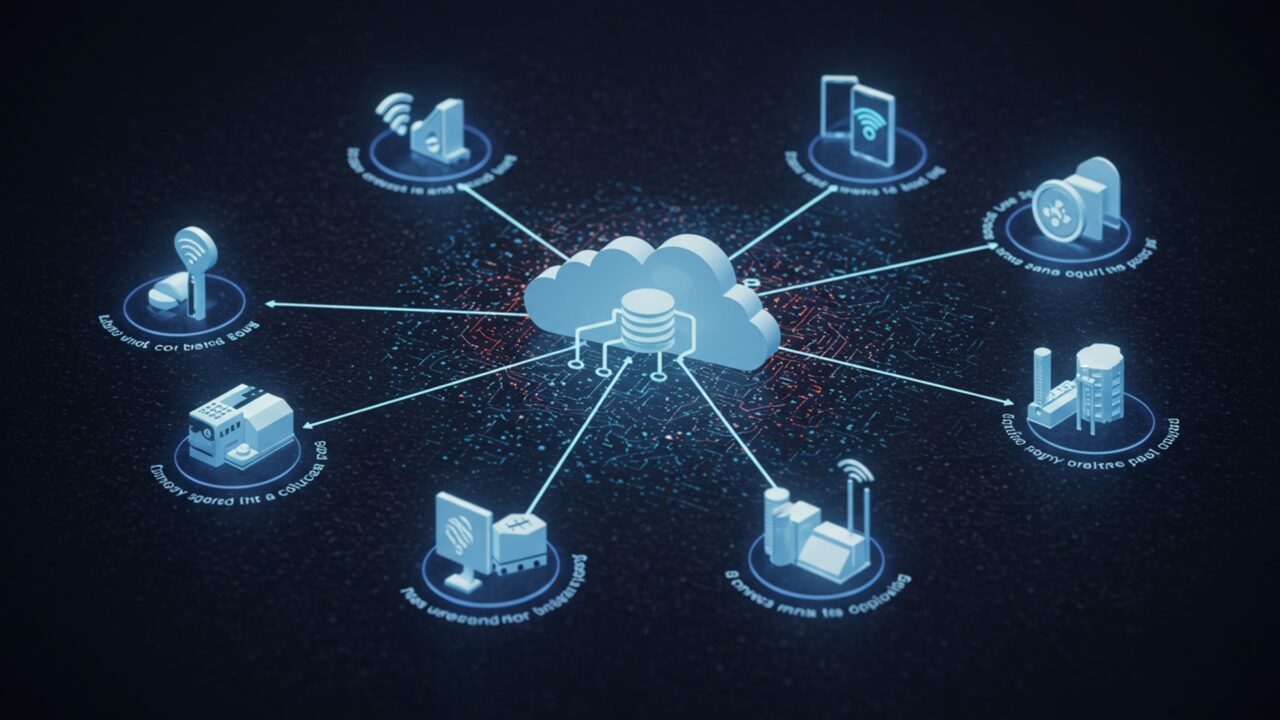
Edge Computing Is Eating Cloud Workloads – What That Means for Latency-Critical Operations
For the past decade, the default architecture for almost any connected system was the same: sensors and devices at the edge, processing and decision-making in a centralized cloud. That model made sense when the primary goal was storage and batch analysis. It makes a lot less sense when the goal is a response measured in milliseconds.
That’s the shift happening now across manufacturing, infrastructure, and public safety operations: processing is moving back out to where the data is actually generated, and it’s happening because centralized architectures simply can’t meet the latency and reliability requirements that real-time operations demand.
Why the Cloud-First Model Hits a Wall
Sending every piece of sensor data to a centralized location for processing, then waiting for a response to travel back, introduces a round trip that’s invisible for a dashboard update and disqualifying for a safety-critical decision. A robotic system on a factory floor, a quality inspection camera on a production line, or a traffic control system managing an intersection can’t wait for a request to travel to a distant data center and back before acting.
The gap shows up clearly in what industrial leaders now say their networks actually need to support real-time operations: reliable connectivity, edge processing capacity, bandwidth, and mobility consistently top the list of critical infrastructure gaps. Wireless reliability in particular is now considered essential by the overwhelming majority of industrial operators, and expectations for connectivity requirements are only rising as more operations shift toward real-time, autonomous decision-making at the equipment level.
What’s Actually Moving to the Edge
Anomaly detection in milliseconds, not minutes. Processing sensor data locally means an anomaly on a factory floor can be flagged and acted on in real time, rather than waiting for a round trip to a centralized system – the difference between catching a problem as it starts and discovering it after the fact.
Machine vision and quality inspection. Automated visual inspection systems generate enormous volumes of image data, far more than makes sense to continuously stream to a central location. Processing that data at the point of capture is both faster and dramatically cheaper than shipping it all to the cloud.
Robotics and autonomous equipment. Systems that need to react to their physical environment in real time – automated guided vehicles, robotic arms, autonomous inspection equipment – depend on local processing because centralized decision-making simply can’t keep pace with a moving physical system.
Localized command and control. For public safety and traffic systems, decisions like adjusting signal timing during an incident or triggering a localized alert can’t wait on a network round trip. Local processing keeps those systems functional even if connectivity to a central system is degraded or temporarily lost.
The Economics Are Pushing in the Same Direction
Beyond latency, there’s a straightforward cost argument for edge processing. Continuously streaming raw sensor and video data to a centralized location for processing is expensive – in bandwidth, in storage, and in compute. Processing at the edge and sending only relevant, filtered results back to central systems can meaningfully cut cloud infrastructure costs, while also reducing the amount of sensitive operational data that has to leave the facility in the first place.
That last point matters more than it might initially seem. For regulated industries and public sector deployments in particular, keeping raw data local and only transmitting processed results can materially simplify data governance and compliance obligations.
This Doesn’t Mean the Cloud Goes Away
The shift toward edge processing isn’t a rejection of centralized infrastructure – it’s a rebalancing. Centralized systems remain the right place for long-term storage, cross-facility analytics, and model training or refinement that benefits from aggregated data across many sites. What’s changing is which decisions get made where: time-sensitive, safety-critical, or bandwidth-heavy processing happens locally, while centralized systems handle the analysis that benefits from a broader view and doesn’t need to happen in real time.
The practical architecture most operators are converging on is hybrid by design: edge nodes handling immediate detection and response, with centralized systems handling longer-horizon analysis, cross-site pattern recognition, and the kind of retraining or tuning that benefits from data pooled across many locations.
What This Means for Infrastructure Planning
For any organization planning latency-sensitive deployments – a factory floor, a smart city traffic network, a distributed public safety system – the question is no longer whether to invest in edge processing capacity, but how much of it, and where. Networks built for yesterday’s dashboard-and-batch-report workloads generally aren’t ready for today’s real-time, equipment-level decision-making, and retrofitting connectivity and edge compute capacity after a deployment is already live is a far harder problem than designing for it up front.
The organizations moving fastest here are treating edge infrastructure as a prerequisite for real-time operations, not an optional add-on layered in after the fact.
If latency is the constraint standing between your current infrastructure and real-time operations, let’s talk through what an edge-first architecture would look like for your environment.