Introduction
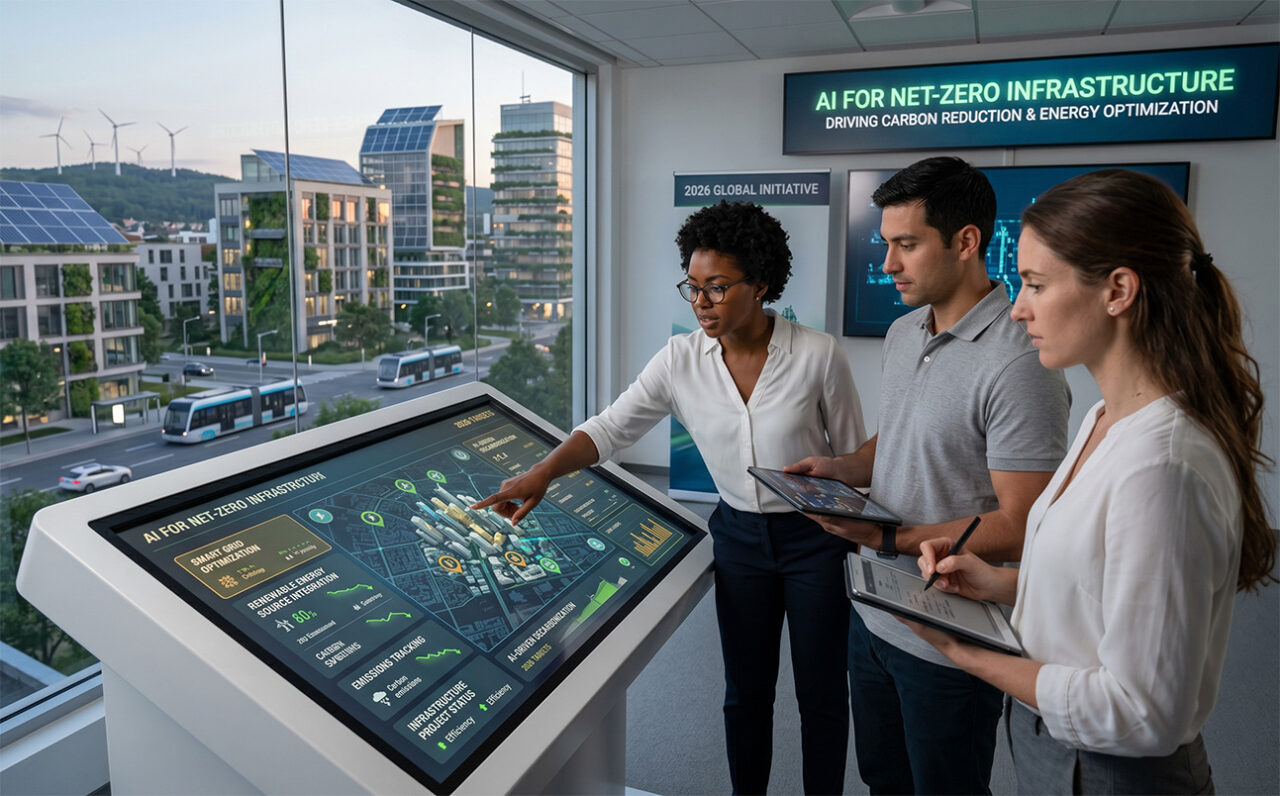
AI for Net-Zero Infrastructure: Driving Carbon Reduction and Energy Optimization Amid 2026’s Strong Government & Corporate Push.
In 2026, sustainability is no longer optional – it’s a regulatory, financial, and operational imperative. Governments and corporations are aligning around aggressive carbon reduction targets, creating unprecedented momentum for energy optimization and decarbonization.
India has set a clear direction: net-zero by 2070, with major interim goals. The Union Budget 2026-27 allocated ₹20,000 crore (~$2.2 billion) over five years specifically for Carbon Capture, Utilisation, and Storage (CCUS) technologies, targeting hard-to-abate sectors like steel, cement, power, refineries, and chemicals. The Carbon Credit Trading Scheme is also gaining traction, turning emissions reduction into a market opportunity.
Globally, AI is emerging as one of the most powerful tools to bridge ambition and results. According to the IEA, widespread adoption of existing AI applications in energy systems could deliver 1,400 Mt of CO₂ emissions reductions by 2035 — three times the projected emissions from data centers themselves.
For infrastructure operators, this convergence represents a historic opportunity.
Why the Push is Stronger Than Ever in 2026
- Regulatory Pressure: Carbon markets, ESG disclosure rules, and mechanisms like the EU’s CBAM are pushing organizations to act.
- Corporate Commitments: Thousands of companies have net-zero pledges, with investors demanding measurable progress.
- Energy Reality: Surging demand from AI, data centers, and urban growth is colliding with the need for cleaner, more efficient operations.
- Economic Incentive: Energy optimization directly lowers costs while generating carbon credits and avoiding future penalties.
Traditional building management and SCADA systems are no longer enough. They lack the predictive power and real-time intelligence needed in today’s dynamic environment.
How AI Delivers Real Carbon Reduction & Energy Optimization
Here’s how AI-powered platforms are making sustainability operational and measurable:
- Real-Time Energy Optimization & Demand Response AI analyzes occupancy, weather, production schedules, and grid signals to dynamically adjust HVAC, lighting, and processes. Results: 15-30% energy savings in buildings and campuses, with even higher gains in industrial settings.
- Renewable Integration & Grid Balancing AI improves forecasting for solar and wind, reduces curtailment, and enables intelligent storage dispatch. This helps facilities increase their renewable share while maintaining reliability.
- Predictive Maintenance for Lower Emissions By preventing failures and optimizing equipment runtime, AI reduces inefficient emergency operations and extends asset life — cutting both operational and embodied carbon.
- Autonomous Digital Twins Digital twins now go beyond visualization to run simulations and enable closed-loop autonomous control of energy systems.
- Automated Carbon Accounting & Compliance AI aggregates Scope 1, 2, and 3 emissions data, identifies hot spots, and streamlines reporting for carbon markets and ESG frameworks.
Real-World Impact Examples:
- AI-driven energy management in industrial facilities has delivered 10%+ average energy savings with payback periods under one year.
- In data centers and critical infrastructure, intelligent cooling and workload optimization are reducing energy use by 15-25% while supporting higher densities.
- Early adopters in smart campuses and public estates report significant drops in operational carbon alongside improved occupant comfort.
Turning Sustainability Goals into Daily Operations
- 25%+ improvement in energy efficiency through real-time insights and automation.
- Predictive and prescriptive actions that reduce carbon footprint without compromising performance.
- Seamless support for CCUS readiness, renewable integration, and net-zero roadmaps.
- Applications across smart cities, airports, manufacturing plants, data centers, and government infrastructure.
Whether it’s optimizing energy in a large campus, balancing loads in a manufacturing facility, or supporting sustainability in critical public infrastructure, Astrikos makes net-zero actionable — not just reportable.
The Next Frontier: Agentic AI for Autonomous Sustainability
In 2026, the conversation is shifting from “optimization” to autonomous operations. Agentic AI systems can continuously monitor, decide, and act — creating self-optimizing infrastructure that adapts in real time to reduce emissions while maintaining uptime and performance.
Organizations that embrace this shift will achieve lower costs, stronger regulatory compliance, and a genuine competitive edge.
Conclusion: Time to Act is Now
The strong government funding, corporate pressure, and technological maturity in 2026 have created perfect conditions for meaningful progress. AI-powered platforms like Astrikos.ai allow infrastructure leaders to move from reactive compliance to proactive leadership in the net-zero transition.
Ready to align your infrastructure with India’s and the world’s sustainability goals?