

Data Centers as Grid Partners: On-Site Generation and Load Flexibility in 2026
For decades, the relationship between data centers and the power grid was simple: the grid generated, the facility consumed. That relationship is breaking down — and 2026 is the year it breaks down for good.
Rack densities that once sat comfortably at 10–15 kW are now routinely pushing past 120 kW, with next-generation designs approaching the megawatt range per rack. Facilities that used to look like large office buildings, electrically speaking, now look like small cities. And the grid that was built to serve stable, predictable industrial and residential load was never designed to absorb the volatile, high-magnitude demand spikes that dense compute workloads create.
The result is a structural shift in how operators think about power — from a line item on a facility budget to a first-order design decision that shapes site selection, construction timelines, and even which workloads a facility can support at all.
The Grid Can’t Move Fast Enough
Much of the grid infrastructure in service today was built between the 1950s and 1970s. A large share of it is approaching the end of its practical life cycle just as electrification accelerates across transportation, buildings, and industrial operations — all competing for the same finite generation and transmission capacity. Permitting and interconnection queues for new power plants and high-voltage transmission lines can take the better part of a decade, while facility construction timelines are measured in months.
That mismatch is forcing a new posture. Operators can no longer treat electricity as something the utility simply delivers on request. They have to treat it as a resource they help produce, store, and manage.
From Consumer to Stakeholder
The most capital-intensive facilities being built today are no longer passive consumers sitting at the end of a transmission line. They are becoming active participants in grid operations, in a few concrete ways:
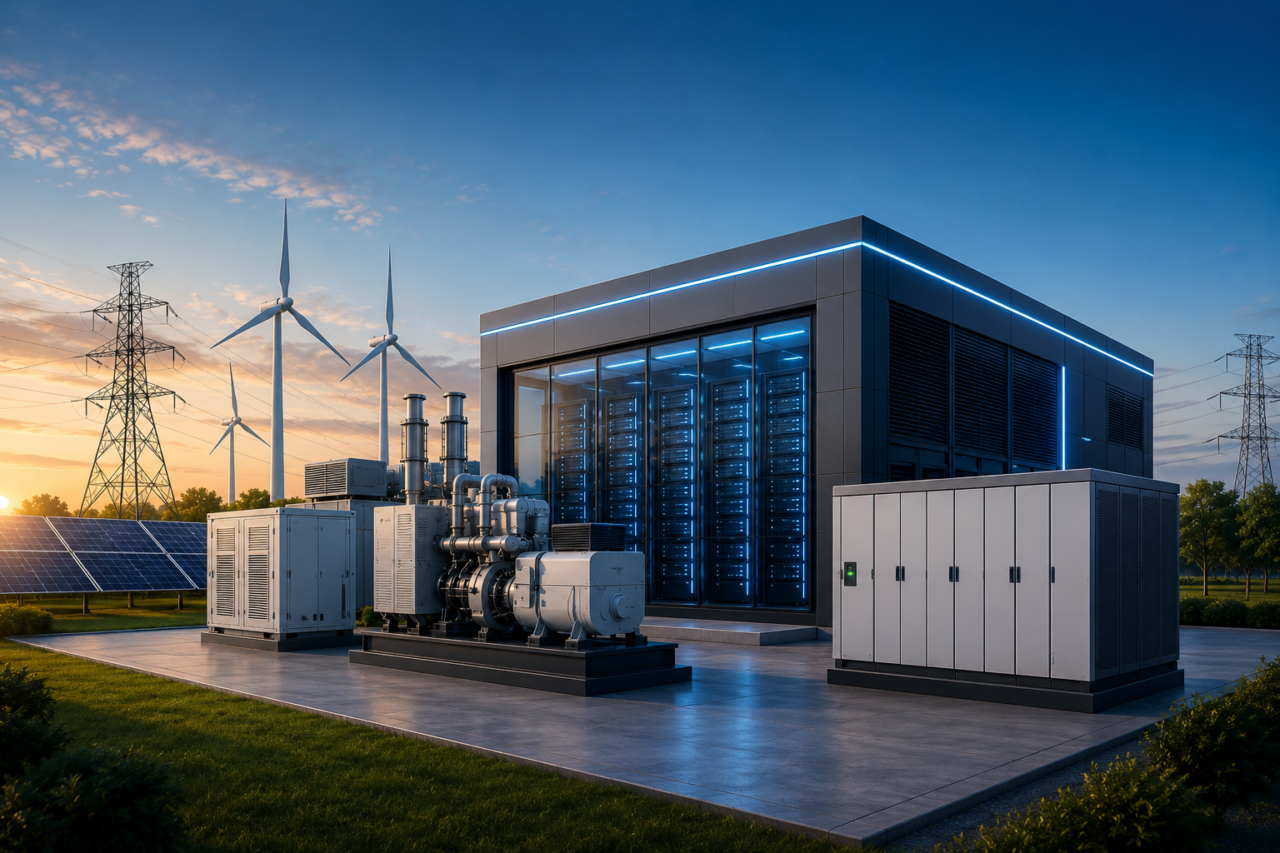
On-site generation as a bridge, not a crutch. Behind-the-meter generation — gas turbines, fuel cells, and increasingly small modular reactors — is being used to get facilities online while grid-connected capacity works its way through interconnection queues. Nuclear adoption for this purpose has roughly tripled in just a few years, a signal that operators see this as a durable part of the power mix rather than a stopgap.
Storage to smooth volatility. Dense compute clusters don’t draw power evenly. Training-style workloads in particular create sharp, dynamic load swings that ripple all the way back to the generation source. Battery storage is becoming essential not just for backup, but for actively managing power quality and meeting emerging grid requirements around ride-through during voltage events.
Co-investment in transmission and generation. Rather than waiting in a queue, some operators are directly funding grid upgrades near their sites — new substations, transmission reinforcement, even generation capacity — in exchange for faster, more reliable interconnection.
Load flexibility as a design principle. Facilities are being architected to shift or shed non-critical load during peak grid stress, turning what was once a fixed demand profile into something the grid operator can actually negotiate with.
Why This Matters Beyond the Facility Fence
This shift has consequences well past the data center campus. Utilities are beginning to treat large compute operators less like customers and more like infrastructure co-developers — entities that can help fund, accelerate, and even stabilize the broader grid rather than simply straining it. For regions competing to attract large-scale digital infrastructure investment, the ability to deliver power quickly is becoming as important as land, connectivity, or tax incentives.
For facility operators and enterprises planning deployments over the next 12–18 months, the practical takeaway is this: power strategy needs to be locked in before compute architecture, not after. Site selection increasingly turns on how fast a region can deliver electricity, not just how much fiber runs through it. And the operators treating power procurement as a facilities afterthought are the ones most likely to find their expansion plans stalled in an interconnection queue.
Building for a Grid-Aware Future
The facilities that will scale smoothly through this decade are the ones designed from day one to operate as grid partners — with generation, storage, and demand flexibility built into the architecture rather than bolted on after a capacity crunch forces the issue. That means closer collaboration between facility engineering teams and utility planners earlier in the design process, and infrastructure that can flex with grid conditions in real time rather than drawing a flat, unmanaged load.
The organizations that get ahead of this shift now will spend the next decade building capacity. The ones that don’t will spend it waiting in line.
Planning infrastructure that needs to scale with confidence in a power-constrained environment? Get in touch with our team to talk through your site strategy.