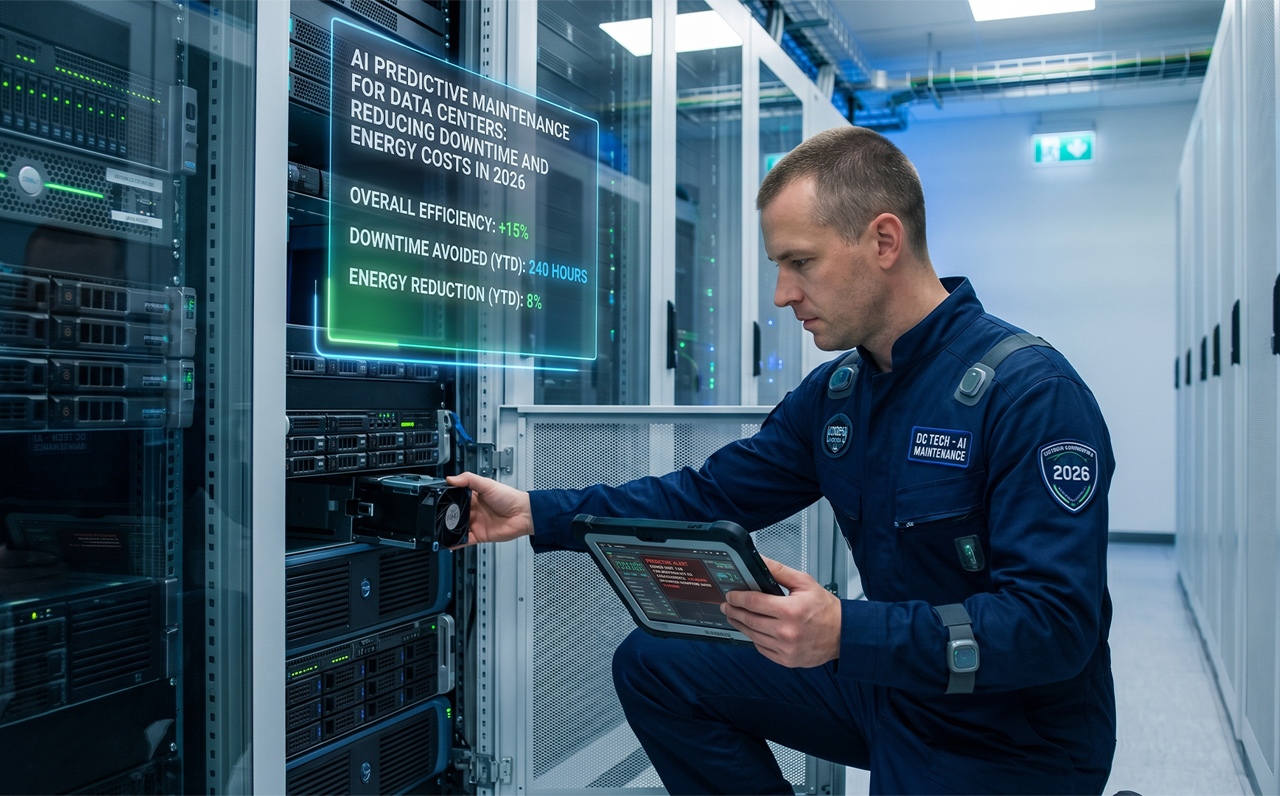
AI Predictive Maintenance for Data Centers: Reducing Downtime and Energy Costs in 2026
Introduction
The AI boom is transforming data centers into high-density powerhouses – but it’s also creating unprecedented challenges. In 2026, data centers face skyrocketing energy demands, tighter sustainability targets, and the need for near-perfect uptime to support critical AI workloads.
India’s data center capacity is projected to grow significantly in 2026, with massive investments driven by AI, cloud, and digital growth. Globally, data centers could consume enormous amounts of electricity, making efficiency more critical than ever.
AI-powered predictive maintenance has emerged as one of the most effective solutions. It shifts operations from reactive fixes to proactive intelligence, helping operators slash unplanned downtime, cut energy waste, and lower operational costs.
The Growing Challenges for Data Centers in 2026
- Explosive AI Workloads: AI training and inference require high-power GPUs, leading to much higher power densities and heat generation.
- Energy Crisis: Cooling alone can account for up to 40% of electricity use. With surging demand, energy costs are rising sharply.
- Downtime Risks: Even brief outages in AI data centers can cost millions in lost productivity and revenue.
- Sustainability Pressure: Operators must meet net-zero goals and carbon regulations while scaling rapidly.
Traditional calendar-based or reactive maintenance simply can’t keep up with these demands.
How AI Predictive Maintenance Works
AI predictive maintenance combines IoT sensors, real-time data analytics, machine learning, and digital twins to monitor equipment health continuously.
Key components include:
- Vibration, temperature, power usage, and humidity sensors on servers, cooling systems, UPS, and generators.
- Machine learning models that detect anomaly patterns and predict failures days or weeks in advance.
- Digital twins that simulate “what-if” scenarios for maintenance scheduling.
- Automated alerts and prescriptive recommendations for operators.
This approach enables condition-based maintenance instead of scheduled or breakdown-based approaches.
Key Benefits in 2026
Here’s what leading operators are achieving:
- Significant Downtime Reduction AI predictive maintenance can reduce unplanned downtime by 35-50% (some cases report up to 70%). This is critical when every minute of downtime in an AI facility can be extremely costly.
- Major Energy Savings By preventing inefficient operation of failing equipment and optimizing cooling dynamically, operators see 15-30% reduction in energy consumption. Google reportedly achieved around 40% cooling energy savings using AI-driven approaches.
- Lower Maintenance Costs Organizations typically report 10-40% reduction in maintenance costs by avoiding emergency repairs and optimizing schedules.
- Extended Asset Life Early intervention extends the lifespan of critical equipment by 20-40%.
- Improved Sustainability Reduced energy use directly lowers carbon footprint, helping meet ESG and regulatory requirements.
Intelligent Predictive Maintenance for Modern Data Centers
Astrikos.ai delivers a unified IT-OT platform designed for critical infrastructure like data centers. Our solution offers:
- Real-time monitoring and predictive analytics across power, cooling, and IT infrastructure.
- Seamless integration with existing SCADA, BMS, and legacy systems.
- Advanced digital twins for simulation and autonomous optimization.
- Actionable insights that move beyond alerts to prescriptive and agentic actions.
Clients using Astrikos.ai typically achieve 25%+ improvement in energy efficiency and substantial reductions in operational risks – making high-density AI operations more reliable and sustainable.
Implementation Guide: Getting Started in 2026
- Assess Current Infrastructure – Map sensors and data sources.
- Choose the Right Platform – Prioritize solutions with strong IT-OT convergence and digital twin capabilities.
- Start with Pilot Areas – Focus on high-impact zones like cooling systems or UPS first.
- Integrate with Existing Tools – Ensure compatibility with your current operations.
- Scale with AI Agents – Move toward autonomous maintenance where systems self-correct minor issues.
The Future: Autonomous & Self-Healing Data Centers
By late 2026 and beyond, predictive maintenance will evolve into agentic AI – where autonomous agents not only predict issues but also take corrective actions in real time, creating self-optimizing, resilient data centers.
Conclusion
In 2026, AI predictive maintenance is no longer a nice-to-have – it’s a competitive necessity for data center operators facing rising energy costs, sustainability demands, and uptime pressures.
Organizations that adopt it now will gain significant advantages in efficiency, reliability, and cost control.